 Advance Your Clinical Skills with Marma Therapy! Admissions Open at AVP Research Foundation. Enrol Today!


AVP Research Foundation | Clinical Care, Research & Ayurvedic Education
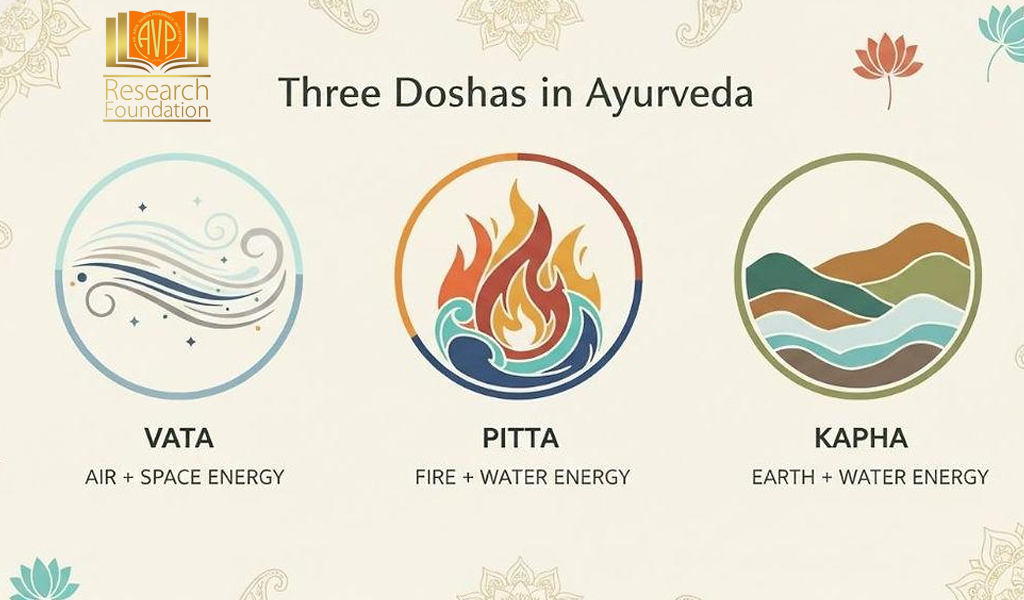
Understanding the Three Doshas: Vata, Pitta and Kapha in Ayurveda
Explore Vata, Pitta and Kapha, the three fundamental doshas in Ayurveda, and understand their traditional role in individual constitution and holistic wellness.
Article
Read the Full Story
Introduction
Ayurveda, India's traditional system of healthcare, offers a unique perspective on understanding the human body, mind and overall well-being. One of its fundamental concepts is the Tridosha theory, which describes three functional principles known as Vata, Pitta and Kapha.
According to Ayurvedic philosophy, these three doshas influence the functioning of the body and are used to understand individual physical characteristics, physiological tendencies and lifestyle requirements.
Every individual is traditionally considered to have a unique combination of all three doshas. Understanding this combination is an important part of Ayurveda's personalized approach to health and wellness.
In this article, let us explore the meaning of Vata, Pitta and Kapha, their traditional characteristics and their importance in Ayurvedic lifestyle practices.
1. What Are the Three Doshas in Ayurveda?
The term Tridosha refers to the three fundamental principles of Ayurveda: Vata, Pitta and Kapha.
Ayurvedic philosophy associates these doshas with the five elements, known as Pancha Mahabhutas:
-
Akasha – Space
-
Vayu – Air
-
Agni – Fire
-
Jala – Water
-
Prithvi – Earth
The traditional associations are:
-
Vata: Space and Air
-
Pitta: Fire and Water
-
Kapha: Water and Earth
Each dosha represents a different set of functional qualities in the Ayurvedic understanding of the human body.
| Dosha | Associated elements | Traditional functional association |
|---|---|---|
| Vata | Space and Air | Movement and communication |
| Pitta | Fire and Water | Transformation and metabolism |
| Kapha | Water and Earth | Structure and stability |
The Tridosha concept provides the foundation for understanding individual constitution and maintaining balance according to traditional Ayurvedic principles.
2. Vata Dosha – The Principle of Movement
Vata is traditionally associated with movement, communication and activity within the body.
It is formed from the elements of space and air and is described through qualities such as lightness, dryness, mobility and variability.
Traditional functions associated with Vata
Vata is traditionally associated with:
-
Movement of the body.
-
Breathing and respiration.
-
Communication between different body systems.
-
Voluntary and involuntary movements.
-
Sensory and nervous system functions in the Ayurvedic conceptual framework.
-
Elimination of bodily waste.
Characteristics associated with Vata Prakriti
People described as having Vata-dominant Prakriti are traditionally associated with characteristics such as:
-
A relatively light body frame.
-
Quick movements and speech.
-
Creative and active thinking.
-
Variable appetite.
-
A tendency towards dry skin.
-
Preference for warmth and regular routines.
These are traditional constitutional descriptions, not medical diagnostic criteria or characteristics that apply to everyone.
Lifestyle considerations in Ayurveda
Traditional Ayurvedic recommendations for Vata include:
-
Maintaining regular meal times.
-
Following consistent sleeping schedules.
-
Eating suitable warm and freshly prepared meals.
-
Practising gentle yoga and relaxation.
-
Avoiding excessive physical and mental strain.
The broader value of these practices is their encouragement of consistency, adequate nutrition and healthy daily routines.
3. Pitta Dosha – The Principle of Transformation
Pitta is traditionally associated with transformation, digestion and metabolic activities.
It is primarily associated with the elements of fire and water. Its traditional qualities include heat, intensity, sharpness and fluidity.
Traditional functions associated with Pitta
Pitta is associated with:
-
Digestion and transformation of food.
-
Metabolic processes.
-
Regulation of body heat in the Ayurvedic framework.
-
Visual perception.
-
Understanding and intellectual activities.
-
Transformation of nutrients.
Characteristics associated with Pitta Prakriti
People described as having Pitta-dominant Prakriti are traditionally associated with:
-
A moderate body build.
-
Strong appetite.
-
Efficient digestion according to Ayurvedic descriptions.
-
Sharp and focused thinking.
-
Goal-oriented behaviour.
-
Sensitivity to excessive heat.
These descriptions belong to the traditional Ayurvedic classification and should not be interpreted as scientifically established personality or metabolic types.
Lifestyle considerations in Ayurveda
Traditional recommendations for Pitta include:
-
Maintaining balanced meal schedules.
-
Avoiding excessive consumption of very spicy foods if they cause discomfort.
-
Staying adequately hydrated.
-
Maintaining a balanced work and rest routine.
-
Including moderate physical activity.
-
Practising relaxation and stress-management techniques.
These habits can support general wellness, although individual dietary requirements vary.
4. Kapha Dosha – The Principle of Structure and Stability
Kapha is traditionally associated with structure, stability, nourishment and lubrication.
It is formed from the elements of water and earth and is described through qualities such as heaviness, coolness, softness and stability.
Traditional functions associated with Kapha
Kapha is traditionally associated with:
-
Structural support of the body.
-
Lubrication of joints.
-
Tissue nourishment.
-
Physical strength and stability.
-
Maintaining bodily cohesion.
-
Supporting endurance.
Characteristics associated with Kapha Prakriti
People described as having Kapha-dominant Prakriti are traditionally associated with:
-
A relatively strong or solid body frame.
-
Steady movements.
-
Stable energy levels.
-
Calm and patient behaviour.
-
Good physical endurance.
-
A tendency towards weight gain in some traditional descriptions.
These are general Ayurvedic descriptions rather than universal physical or psychological characteristics.
Lifestyle considerations in Ayurveda
Traditional Ayurvedic practices for Kapha include:
-
Maintaining regular physical activity.
-
Avoiding prolonged sedentary habits.
-
Eating balanced meals according to individual nutritional needs.
-
Including a variety of vegetables and fibre-rich foods.
-
Maintaining consistent daily routines.
-
Practising suitable yoga and physical exercises.
Regular physical activity and balanced nutrition are also supported by modern public health recommendations.
5. What Is Prakriti? Understanding Your Individual Constitution
One of the most interesting concepts in Ayurveda is Prakriti, which refers to an individual's constitutional nature.
According to traditional Ayurvedic philosophy, each person has a unique combination of Vata, Pitta and Kapha. The relative predominance of these doshas forms the basis of individual constitutional classification.
The commonly described seven Prakriti types are:
-
Vata-dominant
-
Pitta-dominant
-
Kapha-dominant
-
Vata-Pitta
-
Pitta-Kapha
-
Vata-Kapha
-
Vata-Pitta-Kapha balanced constitution
Understanding Prakriti is traditionally used by Ayurvedic practitioners to guide individualized dietary, lifestyle and healthcare recommendations.
However, modern scientific research has not yet established Prakriti classification as a fully validated diagnostic or biological system. A 2025 critical review found that existing assessment tools vary considerably in their scientific validation and reliability.
Therefore, online dosha questionnaires should not be used to diagnose health conditions or determine medical treatment.
6. What Does Dosha Imbalance Mean in Ayurveda?
Ayurveda uses the concept of Vikriti to describe a person's current dosha state, in contrast to Prakriti, which represents their constitutional pattern.
Traditional Ayurvedic assessment considers factors such as diet, sleep, seasonal changes, physical activity, stress and environmental influences when evaluating changes in dosha patterns.
An Ayurvedic practitioner may consider these factors when recommending appropriate lifestyle adjustments.
It is important to understand that dosha imbalance is an Ayurvedic clinical concept, not a laboratory diagnosis. Symptoms such as fatigue, digestive discomfort or sleep disturbances can have many possible causes and should be medically evaluated when persistent or concerning.
7. The Relevance of Tridosha in Modern Healthcare
The Tridosha concept remains an important part of Ayurvedic education, clinical reasoning and traditional healthcare practice.
Contemporary research is exploring whether Ayurvedic constitutional classifications can be assessed using reproducible methods and whether they have measurable relationships with biological characteristics.
Research areas include:
-
Standardization of Prakriti assessment.
-
Clinical evaluation of individualized Ayurvedic interventions.
-
Studies exploring genetic and physiological associations.
-
Safety and quality evaluation of Ayurvedic medicines.
-
Integration of traditional knowledge with evidence-based healthcare.
However, the three doshas should not be directly equated with established biomedical systems or considered proven biological mechanisms.
Responsible research and well-designed clinical studies are necessary to understand their potential relevance in modern healthcare.
Conclusion
Vata, Pitta and Kapha are the three fundamental doshas described in Ayurvedic philosophy. Each represents a distinct group of traditional functional principles associated with movement, transformation and structure.
Understanding the Tridosha concept provides valuable insight into how Ayurveda approaches individual constitution, dietary practices and lifestyle management.
As Ayurveda continues to develop through education and scientific research, it is important to preserve traditional knowledge while evaluating healthcare claims through reliable evidence.
At AVP Research Foundation (AVPRF), we encourage the study of traditional Ayurvedic principles, scientific exploration and responsible healthcare education to promote a better understanding of Ayurveda in modern society.
Disclaimer: This article is intended for general educational purposes only. Ayurvedic dosha classifications are traditional concepts and are not substitutes for medical diagnosis. Consult a qualified healthcare professional for individual health concerns and treatment decisions.
References
References
- World Health Organization. WHO Benchmarks for the Practice of Ayurveda. Geneva: WHO, 2022.
- Venkatesh A, et al. Prakriti (constitutional typology) in Ayurveda: A critical review of Prakriti assessment tools and their scientific validity. Frontiers in Medicine. 2025;12:1656249. doi:10.3389/fmed.2025.1656249.
- Hankey A. A test of the systems analysis underlying the scientific theory of Ayurveda's Tridosha. Journal of Alternative and Complementary Medicine. 2005;11(3):385–390.
- Patwardhan B, et al. Translating Ayurveda's Dosha-Prakriti into objective parameters. Journal of Ayurveda and Integrative Medicine. 2014.
Keep Reading
Related Articles


Need Personalised Ayurvedic Guidance?
Speak with our specialists and receive a treatment plan tailored to your health needs.
Book an Appointment